The humanizer that shows its work.
Most AI text sounds the same. Offbeat finds the flat rhythm and the stock phrasing with a deterministic analyzer, rewrites what needs rewriting, then measures the result against your original. A scorecard and a diff, not a promise.
Humanize something See a real example
Free while in beta. No signup. The analyzer runs in your browser.
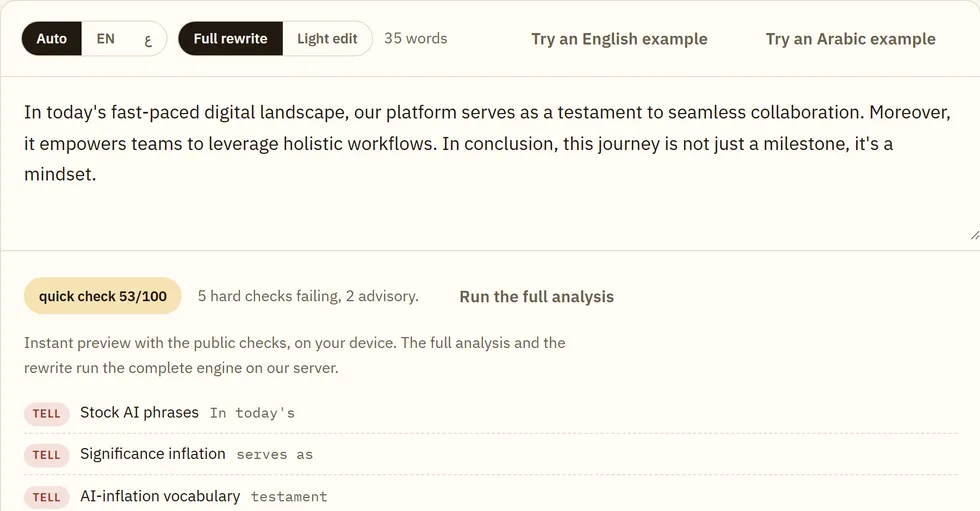
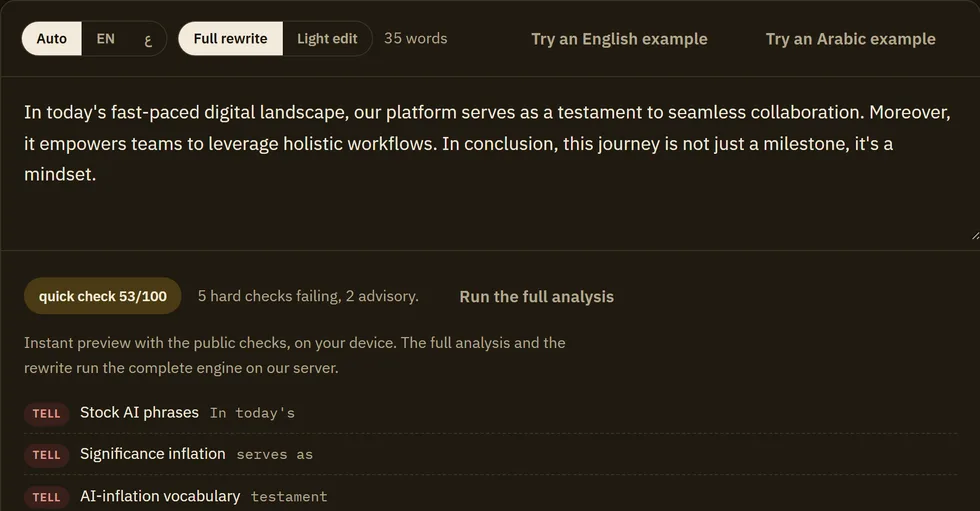
Instant preview with the public checks, on your device. The full analysis and the rewrite run the complete engine on our server.
| check | before | after |
|---|
What changed, and why:
Every changed word:
Your key, your quota, your data terms
The key stays in this browser session, rides each request, and is never stored or logged. Google AI or Anthropic keys, or any OpenAI-compatible endpoint.
Other humanizers ask you to trust them.
This one hands you the measurements.
Deterministic analysis
Twenty-plus checks with named evidence: sentence-rhythm variance, inflation vocabulary, stock phrases, punctuation habits. Every flag points at the exact words that triggered it, so you can disagree with it.
The closed loop
The rewrite is drafted several ways by more than one model, each draft is scored by the same analyzer you just saw, and a separate reviewer model guards the meaning before anything ships. If nothing beats your original, it says so instead of pretending.
Your facts stay put
Code blocks, links, names, and numbers are shielded before the model ever sees the text, then verified after. In our English demo the code fences came back byte-identical, and we check that on every single run.
Arabic as a first language
An independent Arabic engine with rules derived from real Arabic corpora, not translated English heuristics. It restores the natural wa- chaining, respects the writer's dialect, and knows a Latin comma is a typo, not an accusation. العربية هنا لغة أولى، لا ترجمة.
One engine, four doors.
Inside your editor
The MCP server gives Claude Code and any MCP-compatible agent the analyzer as native tools; your editor's model does the rewriting. One command to install, and the guide walks the whole loop.
In the terminal
Scan a file, gate CI on prose quality, or run the closed loop with the model you already have. Writing quality as an exit code.
With your own key
Bring a key from your own provider and rewrite on your quota, under your data terms. Two minutes to set up, kept in your browser only.
Right here
The tool above is the whole product too: quick check, full analysis, rewrite, scorecard. The guide explains every number on it.
The whole eval suite, on one chart.
Twenty texts across genres in both languages, every one run through the engine behind this tool and scored by the same analyzer. Mean gain 21.1 points; 14 of 20 beat their original. Where a rewrite did not beat the original, the tool said so instead of claiming credit.
| Text | before | after |
|---|---|---|
| Blog post | 16 | 77 |
| 20 | 77 | |
| Product copy | 40 | 40 |
| Report | 29 | 29 |
| Social post | 39 | 93 |
| Tech docs | 37 | 79 |
| News item | 73 | 98 |
| Abstract | 83 | 98 |
| Blog post | 73 | 96 |
| Social post | 71 | 98 |
| Announcement | 84 | 98 |
| Tech docs | 74 | 98 |
| Fact stack | 87 | 87 |
| Corporate page | 69 | 87 |
| Repetitive draft | 87 | 87 |
| Long report | 42 | 42 |
| Corporate page | 77 | 100 |
| Clean essay | 96 | 98 |
| Dialect post | 79 | 98 |
| Long abstract | 81 | 98 |
Numbers come from the latest committed run of the eval suite in the repo; run it yourself and compare. Every hosted rewrite today also has to convince a separate reviewer model that the meaning survived before it ships.
Full before-and-after examples with scorecards
English blog post, worst fixture in the committed eval set: 9 failing hard checks cut to 2, stock phrases and inflated closers stripped out.
Arabic technical docs from the same run: every hard check passing after the rewrite, and the code fences back byte-identical.
This site eats its own cooking: every page, both languages, must pass the analyzer or the build fails, this sentence included. How we dogfood
Not a detector-evasion tool. On purpose.
Detectors misfire in both directions, and gaming them is a race we refuse to enter. Offbeat exists to make writing genuinely better: varied rhythm, concrete verbs, a point of view. Text that reads well because it is well written.
The launch month is open to everyone. After it, signing in starts your own free trial, and premium continues at $5 a month; the instant preview keeps running in your browser. The honest version of the pricing story